

If you’re eager to truly explore a place and discover the personalities that have shaped it, join us on this journey through the deeds&misdeeds of the Italians!
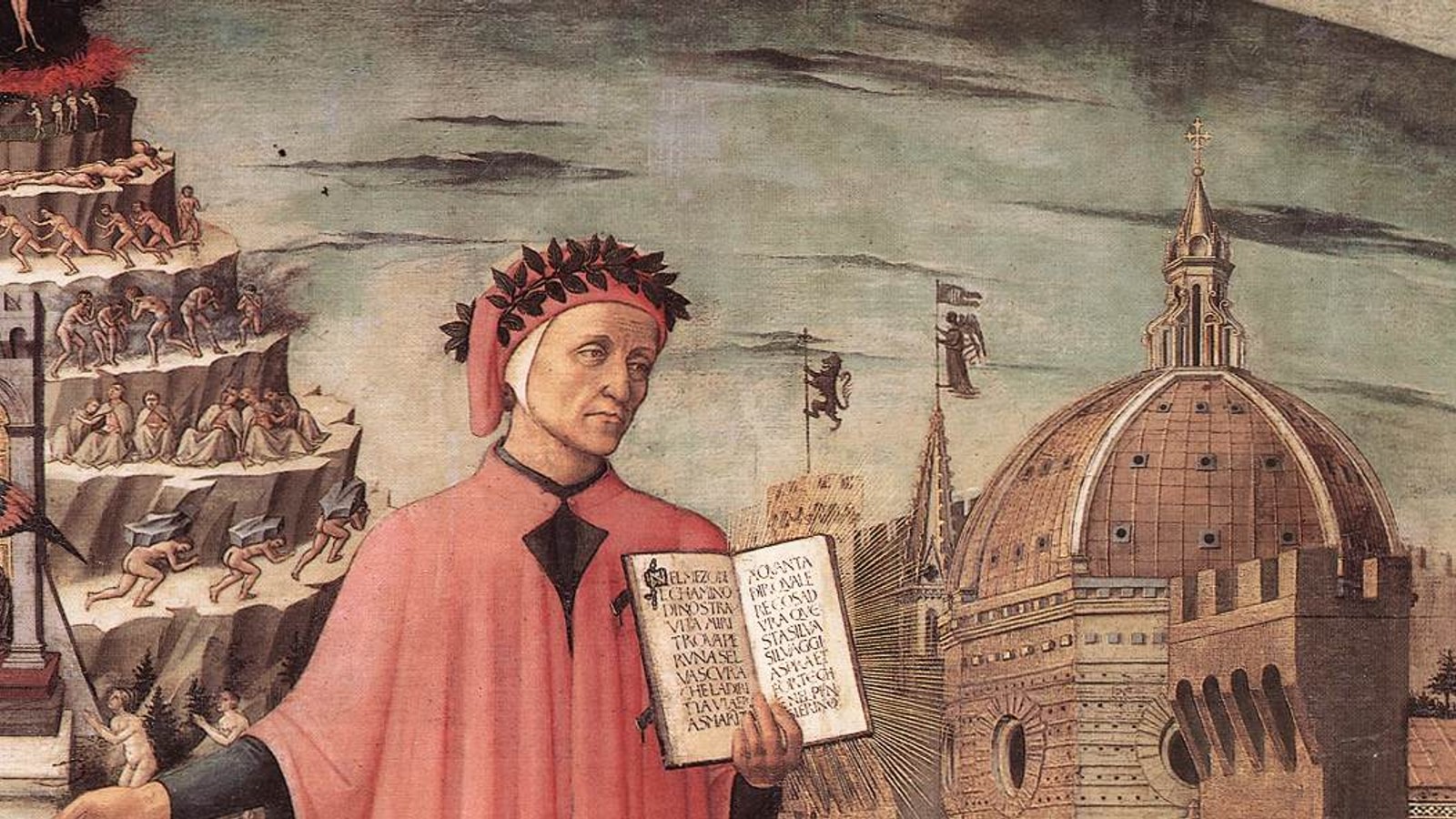
On March 21st, we celebrate World Poetry Day and each year we mark the occasion by honoring the words of the Italian poets who have shaped the way we feel, think, and see the world. Among them, the timeless masterpiece of Divina Commedia by Dante Alighieri stands as both a historical testament and a profound spiritual and literary legacy.
It tells the story of Dante himself, guided by the Roman poet Virgil, as he journeys through Hell, ascends the mountain of Purgatory, and ultimately reaches the realms of Paradise. Along the way, Dante encounters a rich cast of characters, historical figures, mythological beings, and individuals inspired by people he knew, each revealing stories of their lives and the choices that shaped their eternal fate.
Let us step into this extraordinary journey and discover some of the places in Italy that inspired Dante’s vision.
Hell
“… I found myself within a dark forest,
for the straight path had been lost.”
(… mi ritrovai per una selva oscura
ché la diritta via era smarrita.)
Dante drew much of his inspiration from his native Firenze and the wider Toscana. But he began writing the Divine Comedy during his exile, having been banished from the city he loved amid the fierce factional conflicts of the time. During these years, he found refuge in various courts across northern Italy, including near Castello di Soave, not far from Verona. Yet Florence and Tuscany remained ever-present in his work: many of the souls he encounters in the Inferno are drawn from real figures of the region, particularly from cities like Pisa, reflecting both personal memory and political commentary. Dante’s imagination, however, extended well beyond his homeland. He found inspiration along Italy’s eastern shores, such as Gradara Castle, as we mentioned in a previous article, as well as in striking architectural landmarks like the Garisenda Tower in Bologna, whose dramatic tilt is said to have inspired one of the visual images of Hell.
Purgatory
“He seeks for freedom, which is so dear.”
(Libertà va cercando, ch’è sì cara.)
In Dante’s vision, the ascent through Purgatory is imagined as the climb of a mountain rising from the middle of the ocean. This striking image may have been inspired by the dramatic profile of the Pietra di Bismantova, a solitary rock formation in central Italy often compared to a natural fortress, whose steep walls and isolated presence echo Dante’s description. Yet the true protagonist of this canto is Rome.
In Dante’s time, Rome was marked by instability and a lack of clear leadership, due to the ongoing conflict between Papacy and Empire. Dante famously describes these two powers as “two suns,” meant to guide humanity, one offering spiritual direction, the other temporal order. Yet, when this balance is lost, confusion arises. For Dante, however, the ultimate responsibility does not lie with the stars or external forces: although the heavens may influence human actions, they do not determine them. Each individual remains free to choose between good and evil, and guided by reason, humanity holds the true power to shape its own destiny.
Paradise
“The love that moves the sun and the other stars.”
(L’amor che move il sole e l’altre stelle)
In the final cantica of the Divina Commedia, Dante’s journey reaches its highest point in a vision of light, harmony, and divine perfection, far removed from any earthly landscape. Yet it is in Ravenna that this vision ultimately took shape. Welcomed in exile at the court of Guido Novello da Polenta, Dante spent his final years in this quiet Adriatic city, where he is believed to have completed the Paradiso. Surrounded by the shimmering mosaics and golden light of Ravenna’s Byzantine heritage, it is easy to imagine how this setting may have inspired the poet’s luminous imagery. In this final vision, love is revealed as the force that governs the entire universe, a perfect harmony that reflects both the divine and the human longing for meaning. In Ravenna, where Dante still rests today, this ultimate insight feels almost tangible: a place where earthly beauty and eternal poetry quietly converge.
Contact us to plan your trip to visit Dante’s Heaven on earth!
