

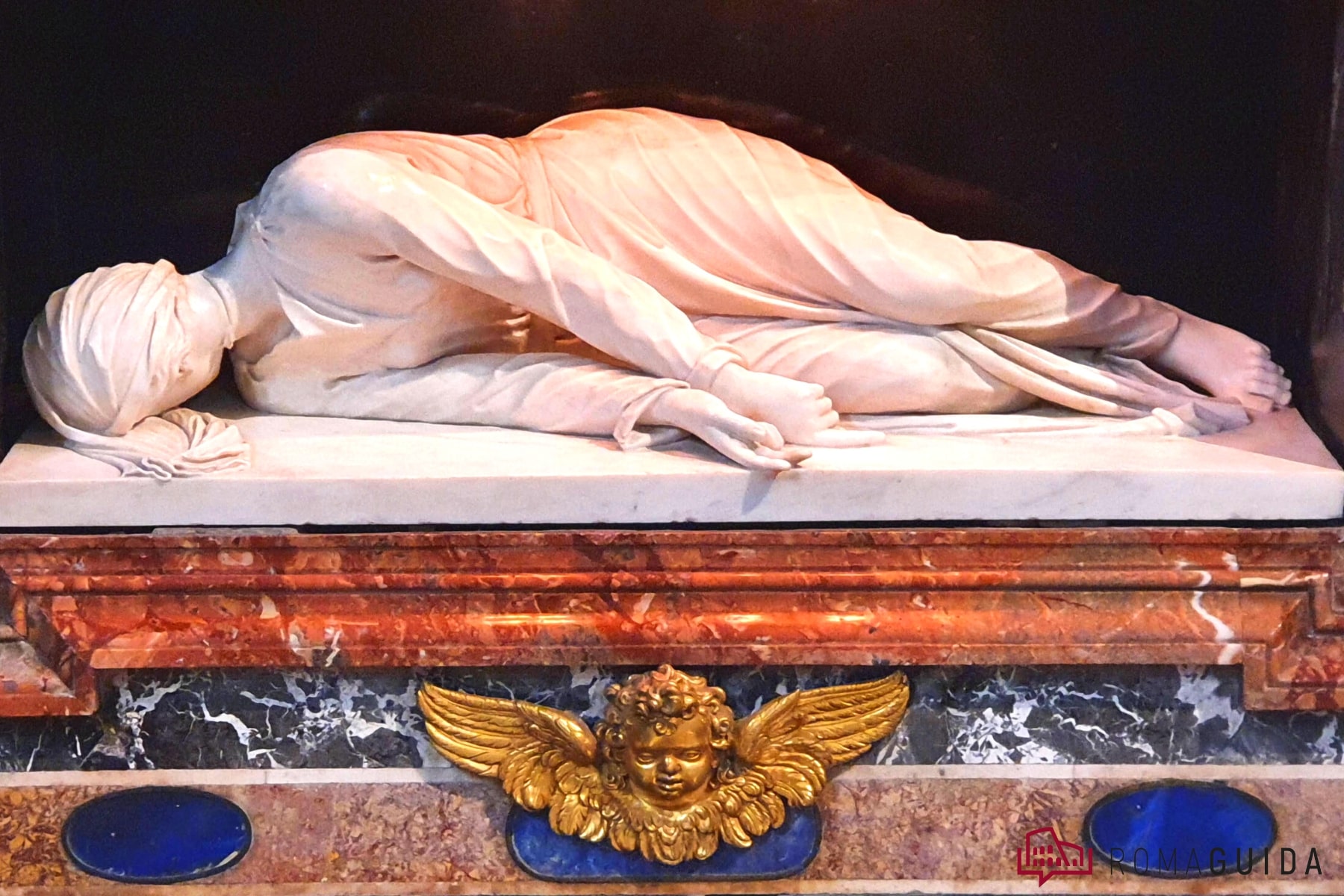
In the picture: Statue of Saint Cecilia, by Stefano Maderno in the church of Santa Cecilia in Trastevere, Rome
It’s Women’s Month, and Lent has officially begun.
The Jubilee is underway in Rome, marking the start of a season filled with celebration—culminating in Easter and the Feast of Corpus Christi later in June. To honor this special time, we’ve decided to highlight some of the most beautiful churches in Rome dedicated to saintly women.
Church of Santa Brigida a Campo de Fiori
The church is part of a complex that includes the house where Saint Bridget lived with her daughter, Saint Catherine, from 1350. Saint Bridget of Sweden was a mystic, nun, and founder of the Bridgettine Order. Born into a noble family, she married and had eight children, including Saint Catherine of Sweden. After her husband’s death, she moved to Rome and devoted herself to religious life, experiencing profound mystical visions and receiving messages from Christ. She founded the Order of the Most Holy Savior, which aimed at promoting monastic life and devotion to Christ. Saint Bridget was canonized in 1391, and she is also a patron saint of Sweden.
Church Trinità dei Monti (Santa Teresa del Bambin Gesù)
One of the most iconic churches in Rome, in one of the most beautiful squares. Pope Francis wanted to associate several churches in Rome with female saints proclaimed Patrons and Doctors of the Church. Because of its connection with France, Trinité-des-Monts will be dedicated to the memory of Saint Thérèse of the Child Jesus, with the installation of a reliquary during 2025. Despite a short life, marked by illness, she developed a deep spirituality, teaching the path of humility, love, and total trust in God. Her works, such as “Story of a Soul”, have become a model of spirituality for millions of people.
Church of Santa Cecilia a Trastevere
Saint Cecilia‘s Basilica was built on the site of the saint’s house, where she was martyred around 230 A.D. Cecilia was tortured for converting her family to Christianity, and her body was buried by Pope Urban I, who consecrated her house as a church. In the 6th century, Saint Gregory the Great elevated it to a Basilica. Pope Paschal I later rediscovered her remains in the catacombs of Saint Callistus and consecrated a new church in 821. In 1599, Cardinal Sfondrati found the saint’s body miraculously intact, after a vision of the saint herself, leading to the creation of Stefano Maderno’s famous statue of the saint, preserved in the church, depicted in the way she was found.
Contact us to plan your trip to Rome for the Jubilee!
